



We are delighted to have you join us for an outstanding weekend of CME, networking, and collaboration with colleagues from across Texas. We encourage you to download the attendee Program and CME presentations below. TSCAP Registration will be on the first floor of Moody Gardens Hotel by the Moody Ballroom (click here for floorplan), where the Exhibit Hall and General Session will take place.
VIRTUAL Kendra Scott Giveback, July 17-18, benefitting the Texas Foundation for Psychiatric Education & Research

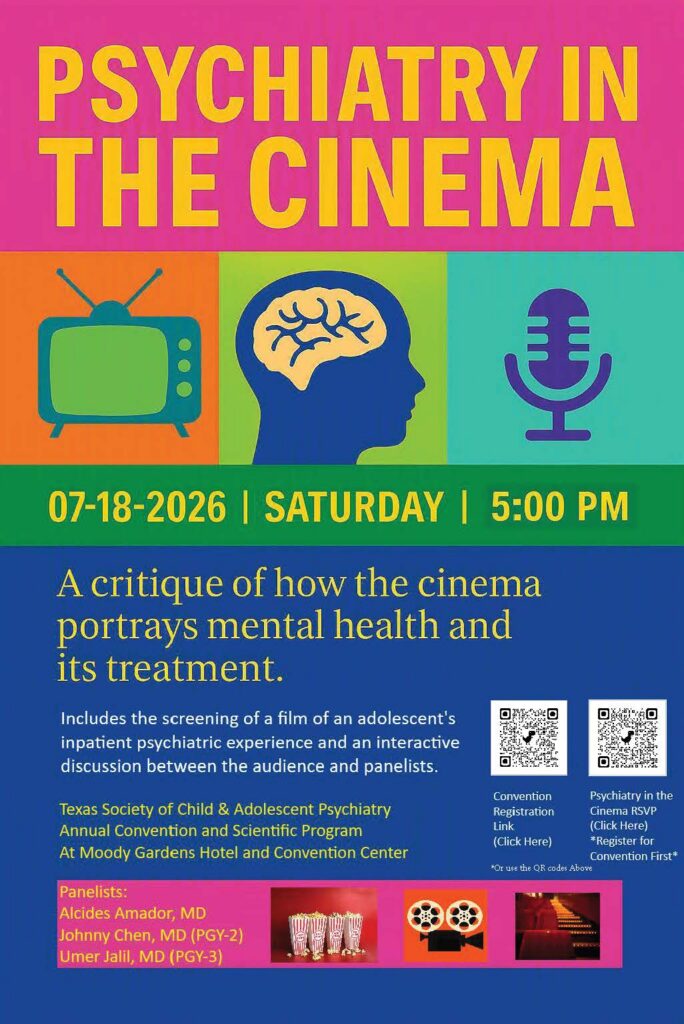
Resident-Fellow and Medical Student members: RSVP Online to join the NEW Psych in Cinema event on Saturday, July 18th!
Moody Gardens Hotel Attractions
Visit Galveston Savings Pass (Galveston Island Savings Pass | Visit Galveston)
This exclusive pass offers discounts at over 20 local restaurants, attractions, and unique island experiences. It’s our way of helping your group discover the best Galveston has to offer while saving money.
Galveston Children’s Museum Summer Camps | Visit Galveston
The Pullman Porters: A Tribute to Juneteenth Exhibit at Galveston Railroad Museum | Visit Galveston
8 AMA PRA Category 1 CreditsTM
with 4 of the Hours designated for Medical Ethics/Professional Responsibility
Saturday July 18, 2026
| 8:05 am – 8:15 am | Opening Remarks |
| 8:15 am – 9:15 am | Transdiagnostic Psychopharmacology: Managing Multiple Comorbidities Steven R. Pliszka, MD |
| Objectives: The learning objectives for this activity has been designed to address clinician competence. Upon conclusion of the activity participants should be able to: – Identify common patterns of psychiatric comorbidity in children and adolescents that complicate medication selection and sequencing. – Prioritize treatment targets when managing co-occurring ADHD, mood, anxiety, and behavioral disorders. – Apply transdiagnostic principles to medication selection and sequencing in complex clinical presentations. – Evaluate the risks and benefits of polypharmacy when managing youth with multiple psychiatric diagnoses. |
|
| 9:15 am – 9:35 am | Refreshment Break with Door Prize Drawings, Exhibitors, and Poster Session |
| 9:35 am – 10:35 am | Clinical and Neurobiological Advances in Ketamine and ECT for Children and Adolescents Joao Luciano de Quevedo, MD, PhD |
| Objectives: The learning objectives for this activity has been designed to address clinician competence. Upon conclusion of the activity participants should be able to: – Apply current evidence and consensus guidelines for the use of ketamine and ECT in children and adolescents with severe, treatment-resistant psychiatric disorders. – Incorporate developmental and family-centered considerations into shared decision-making for somatic treatments in pediatric populations. – Compare ketamine and ECT in pediatric practice with respect to speed of response, durability, safety, and clinical appropriateness. – Discuss emerging research, regulatory considerations, and future directions in somatic treatments for pediatric psychiatry. |
|
| 10:35 am – 10:55 am | Refreshment Break with Door Prize Drawings, Exhibitors, and Poster Session |
| 10:55 am – 11:55 am | Emerging Evidence and Clinical Translation in Transcranial Magnetic Stimulation Emine Rabia Ayvaci, MD |
| Objectives: The learning objectives for this activity has been designed to address clinician competence. Upon conclusion of the activity participants should be able to: – Apply current evidence and clinical guidance to the appropriate use of transcranial magnetic stimulation (TMS) in children and adolescents with psychiatric disorders. – Implementing age-appropriate TMS protocols, dosing parameters, safety monitoring, and outcome evaluation in pediatric populations. – Evaluate safety and tolerability considerations, including consent/assent and family-centered care. – Recognize evolving research, regulatory considerations, and future directions impacting the use of TMS in child and adolescent psychiatry. |
|
| 12:00 pm – 1:00 pm | Legislative Luncheon |
| 1:00 pm – 2:00 pm | Psychopharmacology Update on Management of Irritability and Aggression in Youth with ASD Alice Mao, MD |
| Objectives: The learning objectives for this activity has been designed to address clinician competence. Upon conclusion of the activity participants should be able to: – Identify first-line medications for managing behavioral symptoms in autism. – Discuss emerging or evidence-supported pharmacologic agents for autism-related symptoms. – Differentiate treatment strategies for ASD with co-morbid ADHD, anxiety, or mood disorders. – Assess risks and benefits of off-label prescribing and complementary agents. – Apply case-based medication decision-making to complex autism presentations. |
|
| 2:00 pm – 2:20 pm | Refreshment Break with Door Prize Drawings, Exhibitors, and Poster Session |
|
2:20 pm – 4:20 pm |
Ethics Panel: Advancing Child and Adolescent Mental Health Care Through Collaboration with Texas Local Mental Health Authorities
|
| 4:20 pm – 4:30 pm | Closing Remarks |
Sunday July 19, 2026
| 9:00 am – 9:15 am | Opening Remarks |
| 9:15 am – 11:15 am | Ethics Panel: Developmentally Informed Advocacy and Accommodations Across Childhood and Adolescence Seema Jacob, PsyD; Myesha Morgan, PhD; Joseph Guillory, MD, PSS |
| Objectives: The learning objectives for this activity has been designed to address clinician competence. Upon conclusion of the activity participants should be able to: – Describe the role of Early Childhood Intervention (ECI) and related early support systems in addressing developmental, behavioral, and mental health needs in preschool-age children. – Recognize ethical considerations unique to early childhood, including developmental vulnerability, parental decision-making, and best-interest standards. – Differentiate educational accommodation mechanisms, including Section 504 plans and Individualized Education Programs (IEPs), as they relate to psychiatric diagnoses and functional impairment. – Discuss psychiatric considerations in homebound instruction, school reintegration planning, and manifestation determinations. – Address ethical and clinical considerations in shared decision-making, guardianship, and capacity assessment for transition-age youth. – Recognize population-specific considerations, including autism spectrum disorder and other neurodevelopmental conditions, during the transition to adulthood. |
|
| 11:15 am – 11:30 am | Closing Remarks |
CME PROGRAM OBJECTIVES / TARGET AUDIENCE This live activity has been designed with didactic lectures supplemented with panel discussion, clinical vignettes, audiovisual presentations, case presentation and discussion in multiple educational sessions. The program is designed to provide its target audience of Child and Adolescent Psychiatrists, Adult Psychiatrists, Pediatricians and Primary Care Physicians with clinically relevant information to advance the physicians’ competence so that they may develop strategies to apply the knowledge, skills and judgement from the educational activity into their practice. Physicians often encounter patients that have both psychiatric and neurologic symptoms related to a single etiology. These conditions are inherently complex and often require additional considerations and collaboration between specialties. The objectives of this program aim to equip the attendees with the ability to better assess and care for patients with a variety of diagnoses, treatment options, and special needs.
IDENTIFIED PRACTICE GAPS / NEEDS ASSESSMENT TSCAP has incorporated into this CME activity the relevant educational needs concerning competence that underlie the professional practice gaps of our participants.
ACCREDITATION STATEMENT This activity has been planned and implemented in accordance with the Essential Areas accreditation requirements and policies of the Texas Medical Association (TMA) through the Joint Providership of the Texas Society of Psychiatric Physicians and the Texas Society of Child and Adolescent Psychiatry. TSPP is accredited by the TMA to provide continuing education for physicians.
CREDIT STATEMENT The Texas Society of Psychiatric Physicians designates this Live Activity for a maximum of eight (8) AMA PRA Category 1 CreditsTM. Physicians should claim only the credit commensurate with the extent of their participation in this activity.
MEDICAL ETHICS and/or PROFESSIONAL RESPONSIBILITY STATEMENT The Ethics Presentation: “Advancing Child and Adolescent Mental Health Care Through Collaboration with Texas Local Mental Health Authorities” has been designated by the Texas Society of Psychiatric Physicians for a total of two (2) credits of education in medical ethics and/or professional responsibility. The Ethics Presentation: “Developmentally Informed Advocacy and Accommodations Across Childhood and Adolescence” has been designated by the Texas Society of Psychiatric Physicians for a total of two (2) credits of education in medical ethics and/or professional responsibility.
FACULTY AND PLANNERS DISCLOSURE POLICY In compliance with the ACCME/TMA Standards for Commercial Support of CME, to assure balance, independence, objectivity and scientific rigor in all of its CME activities, prior to the education activity being delivered to the learners, the Texas Society of Psychiatric Physicians implemented a mechanism to identify and resolve personal conflicts of interest from everyone who was in a position to control the content of the education activity. TSPP will disclose to learners the existence (or non-existence) of all relevant financial relationship(s) that the faculty and planners did (or did not) have with any ineligible companies concerned with the content of the educational presentation. Disclosure will occur prior to the presentation through written communication.