





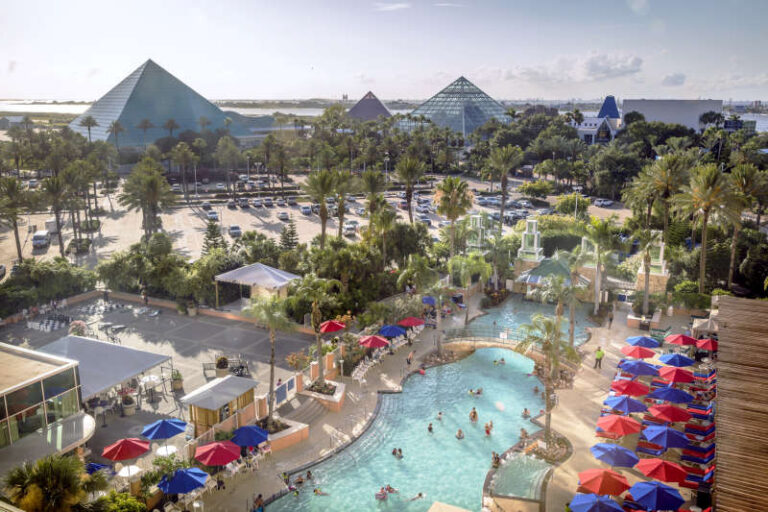
MEETING LOCATION: Join us for the 2026 TSCAP Annual Convention! Set on Galveston Island, the Moody Gardens Hotel, Spa and Convention Center offers a resort-style experience surrounded by 242 acres of attractions and tropical gardens. Attendees can enjoy amenities such as indoor and outdoor pools, a full-service spa, fitness facilities, golf, and multiple dining options, along with easy access to Moody Gardens’ signature attractions including the Aquarium and Rainforest Pyramids, IMAX theater, and nearby beaches.
Whether you plan to travel alone or with your family, there’s fun for everyone at Moody Gardens, located at 7 Hope Blvd, Galveston, TX 77554. Early Bird Registration Now Open!
OPENING WELCOME RECEPTION FRIDAY
Make plans to attend the complimentary festive Welcome Reception with Exhibitors on Friday evening, 6:30pm – 8:00pm. Visit throughout the evening with your friends, colleagues and exhibitors in a fun-filled atmosphere and complete your entry for the special door prize drawings to be awarded Saturday!
SATURDAY – POSTER SESSION
Medical Students, Residents and Fellows in Training who are members of AACAP/TSCAP, APA/TSPP or TAP will present/display posters at the conference throughout the day on Saturday, July 18th.
Click here to submit an abstract for consideration.
Submission deadline: May 15th
HOTEL RESERVATIONS
TSCAP has negotiated a discounted rate for conference attendees and sponsors, available until June 25th. Click here to book your stay today.
IMPORTANT NOTICE: You MUST be registered for the TSCAP conference to qualify for the discounted TSCAP hotel rate. Guests with reservations within the TSCAP group block who are not conference attendees will be notified of their reservation cancellation. TSCAP negotiates these discounted rates as a benefit to conference attendees, to ensure all attendees have accommodations. Please do not share the group link with family/friends who are not attending the CME Scientific Program.
CME SCIENTIFIC PROGRAM
The CME Scientific Program will be held on Saturday and Sunday, for a total of 8.0 AMA PRA Category 1 Credits™.
EXHIBIT HALL
TSCAP’s Welcome Reception, Breaks, Meals and Door Prize Drawings will be held in the Exhibit Hall. Exhibits will be open during the Welcome Reception Friday, and throughout the day Saturday, and will provide you with information designed to enhance your practice and improve the optimal delivery of medical care to your patients.
Click here to sign up as a Sponsor or Exhibitor!
ANNUAL MEETING BREAKFAST
The Annual TSCAP Business Meeting and Breakfast will be held Sunday, 8:00 am – 9:00 am. Register to attend for an annual review from TSCAP, and to help plan for the year ahead!
Friday, July 17
4:30 pm – 8:30 pm Registration
4:30 pm – 6:00 pm Exhibitor set-up
5:00 pm – 6:30 pm TSCAP Executive Committee Meeting
6:30 pm – 8:00 pm Welcome Reception with Exhibitors
Saturday, July 18 Six (6) AMA PRA Category 1 CreditsTM
7:00 am – 3:00 pm Registration
7:30 am – 8:15 am Continental Breakfast in the Exhibit Hall
7:00 am – 5:00 pm Exhibits & Posters
8:15 am – 4:30 pm SCIENTIFIC PROGRAM: “Advances in Child and Adolescent Psychiatry”
9:15 am – 9:35 am Break with Exhibitors and Poster Session
10:35 am – 10:55 am Refreshment Break with Door Prize Drawings, Exhibitors, and Poster Session
12:00 pm – 1:00 pm Legislative Luncheon Program
2:00 pm – 2:20 pm Refreshment Break with Door Prize Drawings, Exhibitors and Poster Session
2:30 pm – 3:00 pm Exhibits & Posters Teardown / Depart
Sunday, July 19 Two (2) AMA PRA Category 1 CreditsTM
8:00 am – 1:00 pm Registration
8:00 am – 9:00 am TSCAP Annual Business Meeting Breakfast
Open to All Registered Attendees. See Registration Form for Payment Information.
9:00 am – 11:30 am SCIENTIFIC PROGRAM: “Advances in Child and Adolescent Psychiatry“
8 AMA PRA Category 1 CreditsTM
with 4 of the Hours designated for Medical Ethics/Professional Responsibility
Saturday July 18, 2026
| 8:05 am – 8:15 am | Opening Remarks |
| 8:15 am – 9:15 am | Transdiagnostic Psychopharmacology: Managing Multiple Comorbidities Steven Pliszka, MD |
| 9:15 am – 9:35 am |
Objectives: The learning objectives for this activity has been designed to address clinician competence. Upon conclusion of the activity participants should be able to: Refreshment Break with Door Prize Drawings, Exhibitors, and Poster Session |
| 9:35 am – 10:35 am | Clinical and Neurobiological Advances in Ketamine and ECT Joao Luciano de Quevedo, MD, PhD |
|
Objectives: The learning objectives for this activity has been designed to address clinician competence. Upon conclusion of the activity participants should be able to: |
|
| 10:35 am – 10:55 am | Refreshment Break with Door Prize Drawings, Exhibitors, and Poster Session |
| 10:55 am – 11:55 am | Emerging Evidence and Clinical Translation in Transcranial Magnetic Stimulation Emine Rabia Ayvaci, MD |
| Objectives: The learning objectives for this activity has been designed to address clinician competence. Upon conclusion of the activity participants should be able to: – Apply current evidence and clinical guidance to the appropriate use of transcranial magnetic stimulation (TMS) in children and adolescents with psychiatric disorders. – Implementing age-appropriate TMS protocols, dosing parameters, safety monitoring, and outcome evaluation in pediatric populations. – Evaluate safety and tolerability considerations, including consent/assent and family-centered care. – Recognize evolving research, regulatory considerations, and future directions impacting the use of TMS in child and adolescent psychiatry. |
|
| 12:00 pm – 1:00 pm | Legislative Luncheon |
| 1:00 pm – 2:00 pm | Psychopharmacology Updates in Autism Spectrum Disorder Alice Mao, MD |
|
Objectives: The learning objectives for this activity has been designed to address clinician competence. Upon conclusion of the activity participants should be able to: |
|
| 2:00 pm – 2:20 pm | Refreshment Break with Door Prize Drawings, Exhibitors, and Poster Session |
| 2:20 pm – 4:20 pm 4:20 pm – 4:30 pm |
Ethics Panel: Advancing Child and Adolescent Mental Health Care Through Collaboration with Texas Local Mental Health Authorities Objectives: The learning objectives for this activity has been designed to address clinician competence. Upon conclusion of the activity participants should be able to: Closing Remarks
|
Sunday July 19, 2026
| 9:00 am – 9:15 am | Opening Remarks |
| 9:15 am – 11:15 am | Ethics: Developmentally Informed Advocacy and Accommodations Across Childhood and Adolescence Seema Jacob; Myesha Morgan; Joseph Guillory, MD |
| Objectives: The learning objectives for this activity has been designed to address clinician competence. Upon conclusion of the activity participants should be able to: – Describe the role of Early Childhood Intervention (ECI) and related early support systems in addressing developmental, behavioral, and mental health needs in preschool-age children. – Recognize ethical considerations unique to early childhood, including developmental vulnerability, parental decision-making, and best-interest standards. – Differentiate educational accommodation mechanisms, including Section 504 plans and Individualized Education Programs (IEPs), as they relate to psychiatric diagnoses and functional impairment. – Discuss psychiatric considerations in homebound instruction, school reintegration planning, and manifestation determinations. – Address ethical and clinical considerations in shared decision-making, guardianship, and capacity assessment for transition-age youth. – Recognize population-specific considerations, including autism spectrum disorder and other neurodevelopmental conditions, during the transition to adulthood. |
|
| 11:15 am – 11:30 am | Closing Remarks |
CME PROGRAM OBJECTIVES / TARGET AUDIENCE This live activity has been designed with didactic lectures supplemented with panel discussion, clinical vignettes, audiovisual presentations, case presentation and discussion in multiple educational sessions. The program is designed to provide its target audience of Child and Adolescent Psychiatrists, Adult Psychiatrists, Pediatricians and Primary Care Physicians with clinically relevant information to advance the physicians’ competence so that they may develop strategies to apply the knowledge, skills and judgement from the educational activity into their practice. Physicians often encounter patients that have both psychiatric and neurologic symptoms related to a single etiology. These conditions are inherently complex and often require additional considerations and collaboration between specialties. The objectives of this program aim to equip the attendees with the ability to better assess and care for patients with a variety of diagnoses, treatment options, and special needs.
IDENTIFIED PRACTICE GAPS / NEEDS ASSESSMENT TSCAP has incorporated into this CME activity the relevant educational needs concerning competence that underlie the professional practice gaps of our participants.
ACCREDITATION STATEMENT This activity has been planned and implemented in accordance with the Essential Areas accreditation requirements and policies of the Texas Medical Association (TMA) through the Joint Providership of the Texas Society of Psychiatric Physicians and the Texas Society of Child and Adolescent Psychiatry. TSPP is accredited by the TMA to provide continuing education for physicians.
CREDIT STATEMENT The Texas Society of Psychiatric Physicians designates this Live Activity for a maximum of eight (8) AMA PRA Category 1 CreditsTM. Physicians should claim only the credit commensurate with the extent of their participation in this activity.
MEDICAL ETHICS and/or PROFESSIONAL RESPONSIBILITY STATEMENT The Ethics Presentation: “Advancing Child and Adolescent Mental Health Care Through Collaboration with Texas Local Mental Health Authorities” has been designated by the Texas Society of Psychiatric Physicians for a total of two (2) credits of education in medical ethics and/or professional responsibility. The Ethics Presentation: “Developmentally Informed Advocacy and Accommodations Across Childhood and Adolescence” has been designated by the Texas Society of Psychiatric Physicians for a total of two (2) credits of education in medical ethics and/or professional responsibility.
FACULTY AND PLANNERS DISCLOSURE POLICY In compliance with the ACCME/TMA Standards for Commercial Support of CME, to assure balance, independence, objectivity and scientific rigor in all of its CME activities, prior to the education activity being delivered to the learners, the Texas Society of Psychiatric Physicians implemented a mechanism to identify and resolve personal conflicts of interest from everyone who was in a position to control the content of the education activity. TSPP will disclose to learners the existence (or non-existence) of all relevant financial relationship(s) that the faculty and planners did (or did not) have with any ineligible companies concerned with the content of the educational presentation. Disclosure will occur prior to the presentation through written communication.